
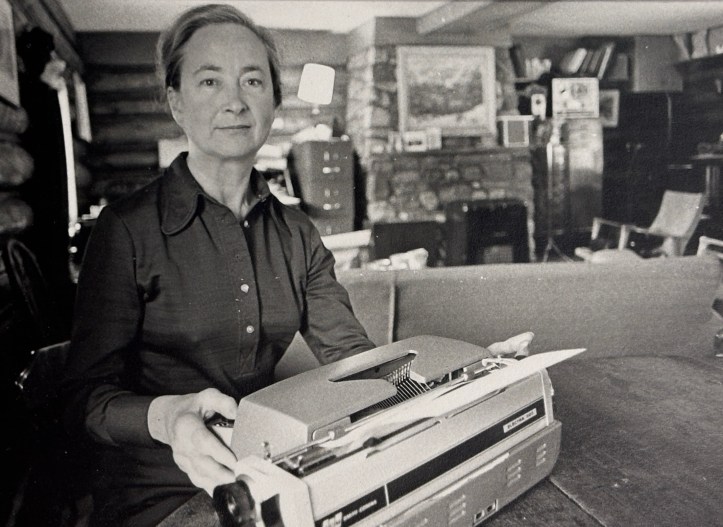
This episode: a story about Hilary McDowall – a journalist based in Lake Louise in the 1960s and 70s. We talk about World War II spies, skiing, failed Olympic bids, and how difficult it can be to be a reporter in a small town without being engulfed in conflicts of interests.
This is part one of a three-part mini-series about Alberta environmental groups and journalists in the 1970s. It was a surprisingly hopeful time for environmentalists in Alberta. Change was in the air, and governments seemed inclined to listen to public demands for conservation. So we’re trying to understand why environmentalists ever talked to journalists, given that half the time they dismissed them as ill-informed city slickers or harmless housewives?
We’re calling this mini-series “You Can Change the World” or “Why Would I Talk To You?”
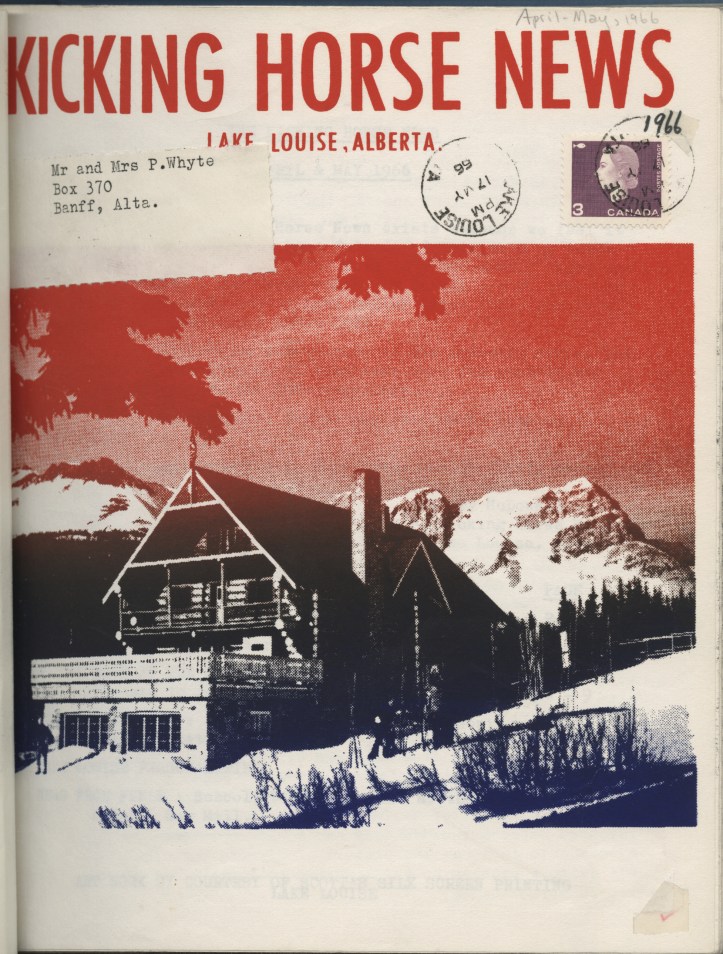
Hilary McDowall’s writing is a fascinating window into the relationship between journalists and environmentalists. She served as the Calgary Herald’s Lake Louise correspondent, and as sole publisher and editor of a tiny publication called the Kicking Horse News. Hilary and her husband Jack lived in the village year-round, letting her offer readers a unique window into local characters, mountain delights, and the seasonal rhythms of the ski resorts.
From the mid-1960s onward, she wrote very critically about environmentalists who opposed bringing the Olympics to the area and expanding housing and highways. There was some key information she chose not to share with readers, though. Her story hints at dilemmas in reporting from a small community in a national park.
Listen to the episode first, then scroll below for some spoilers.

In 1966, the International Olympic Committee voted to award the 1972 Games to Sapporo, over Banff. Hilary wrote scathing editorials blaming wildlife conservationists for this defeat, describing them as outsiders from places like Toronto and New York who knew nothing about human-animal relationships in a game preserve. “Honourable in their intent, ill-informed in their opinions, unbalanced in their judgements, self-satisfied and savage in their intolerance, they were happy to stigmatize as sordid and mercurial the efforts of those who were labouring for this national goal,” she wrote. “As the Lake Louise ski area manager put it, ‘Seldom has so much benefit for so many been frustrated by so few.’”[1]
Her frustration was just as high in 1972, when the federal government rejected the Village Lake Louise proposal from Imperial Oil and Lake Louise Lifts. In an October 1972 editorial, she argued that Minister Chrétien only bowed to “noisy opposition […] based in ignorance” because an election was coming up.[2] “We do not know how the idea originated that the Lake Louise Lifts – Imperial Oil proposal provided only for the rich,” she wrote, but the fear of high prices was already scaring visitors away.[3] And in all the publicity, she said, nobody had mentioned that Lake Louise residents were already suffering from a lack of housing and ordinary amenities.
What Hilary chose not to mention was her own connection to the proponents. Her husband Jack had been managing director of Lake Louise Lifts and its parent company, Ski Club of the Canadian Rockies, owned by Norman Watson.[4] This was actually why they moved to the park: because Watson offered Jack work building ski lifts for his resorts.[5] Lake Louise Lifts was also one of the businesses that sponsored the Kicking Horse News in its early days. Hilary, meanwhile, had worked as a bookkeeper and accountant for Watson’s Post Hotel, where Jack was a manager. These relationships do not seem to have been explicitly disclosed in Kicking Horse News coverage of the Village Lake Louise proposal, nor in articles Hilary wrote for the Herald defending Watson’s reputation.
Research for this mini-series was supported by the Whyte Museum of the Canadian Rockies’ Lillian Agnes Jones Scholarship. They hold a complete collection of Kicking Horse News issues, and many drafts and letters Hilary McDowall wrote.
Read Chris’ full research paper on this topic: “‘You Can Change the World’: Environmental Advocacy and Media in 1970s Alberta.”
This episode is brought to you by Skirtsafire, Edmonton’s annual festival featuring the work of women in the arts. This year’s festival takes place from March 5 to 15, 2026.
This episode is also brought to you by Taproot Edmonton, the best source of reliable intelligence about the Edmonton region. Check out Taproot’s podcast Speaking Municipally every Friday to hear the latest about what’s going on at city hall.
[1] It is reasonable to assume the manager is either Jack McDowall or Norman Watson. Hilary McDowall, “Editorial: End of a Dream,” Kicking Horse News, April-May 1966, 3.
[2] Hilary McDowall, “Village Lake Louise,” Kicking Horse News, October 1972, 2.
[3] McDowall, “Village Lake Louise,” 3.
[4] Qi Chen, “Who Won the Battle of Village Lake Louise?: Park Planning, Tourism Development, and the Downhill Ski Industry in Banff National Park, 1964-1979,” Master’s thesis, (University of Alberta, 2015), 5.
[5] “Handwritten biography: Hilary McDowall.” Documents. 1960-1983. Hilary McDowall fonds. M66. Archives and Library, Whyte Museum of the Canadian Rockies; Hilary McDowall to Magazine Editor’s Desk, “Sir Norman Watson,” November 14, 1965. Calgary Herald. 1960-1983. Hilary McDowall fonds. M66. Archives and Library, Whyte Museum of the Canadian Rockies.; Alan Mettrick, “McDowalls are leaving Lake Louise and an unusual paper writes ‘30’,” Calgary Herald, April 28, 1973.
Further Reading
Sarah-Louise Miller, Women in Allied Naval Intelligence in the Second World War: A Close Secret.
Liza Piper and Jonathan Clapperton, “Introduction | In the Shadow of the Green Giants: Environmentalism and Civic Engagement,” in Environmental Activism on the Ground: Small Green and Indigenous Organizing, ed. Liza Piper and Jonathan Clapperton, Canadian History and Environment Series (University of Calgary Press, 2019)
 Let's Find Out
[…] Part 1: Hilary McDowall and the Kicking Horse News […]
LikeLike
[…] Part 1: Hilary McDowall and the Kicking Horse News […]
LikeLike